
The Two-Speed Job Market: Why AI Startups Are Hiring While the Rest of the Economy Freezes
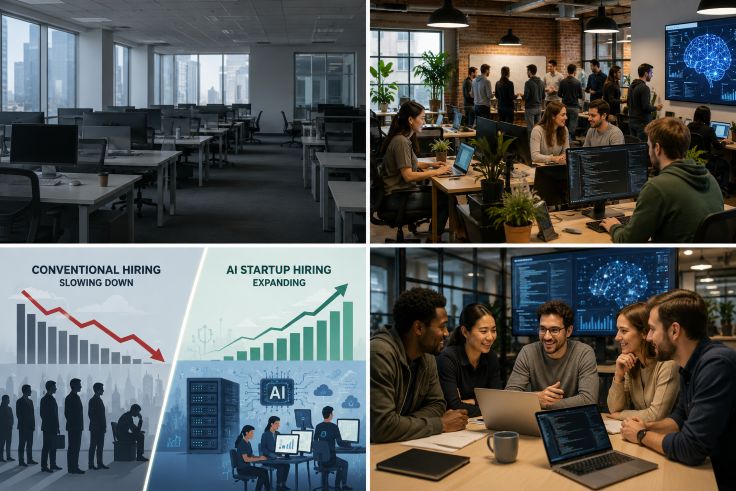
U.S. payroll employment fell by 23,000 jobs in July 2026, a sharp contrast with the hiring activity still visible across the artificial intelligence sector. Data from the U.S. Bureau of Labor Statistics shows that unemployment held at 4.1%, while the civilian labor force shrank by 264,000 people. The broader picture is a labor market with very little momentum.
AI companies tell a different story. The Fast AI Jobs hiring database tracked 29,840 openings across 1,948 AI companies as of August 30. More than 5,600 positions had been added during the previous week. The numbers do not mean every AI startup is booming, but they reveal a concentrated pocket of demand at a time when many workers are finding fewer conventional openings.
Where Is the Job Market Losing Ground?
The slowdown is uneven. July figures from the U.S. Bureau of Labor Statistics show employment falling by about 53,000 in government, 40,000 in leisure and hospitality, 19,400 in retail trade and 14,000 in financial activities. Health services, construction and professional and business services performed better.
Even startups overall are hiring more cautiously than during the technology boom. Carta reported that venture-backed companies on its platform made 26,030 hires in January 2026. That was the weakest January since 2018 and 65% below the January 2022 peak.
AI Investment Is Creating a Different Hiring Cycle
The important difference is where venture money is flowing. Carta found that AI companies captured roughly 40% of startup investment on its platform during 2025. Their share rose to 54% in early 2026. That concentration gives AI-focused businesses more resources to recruit selectively, even while the wider startup economy remains cautious.
The opportunities extend beyond machine learning researchers. Fast AI Jobs lists companies working across AI infrastructure, developer tools, enterprise software, fintech, healthcare, cybersecurity and automation. Another hiring tracker, Rocketlist, counted 6,935 active AI and machine-learning roles in July, making the category its largest hiring vertical.
What Changes When Workers Choose Startups?
For people facing fewer openings at established employers, venture-backed companies can offer another route. Engineering and infrastructure remain important, but growing AI businesses also need people who can turn technology into usable products. That creates demand across product development, implementation, sales, customer support and operations.
Still, startup employment is not a simple replacement for a traditional corporate career. Carta finds that startups are increasingly building smaller teams and expecting them to accomplish more with AI tools. Employees may gain broader responsibilities and equity opportunities, but they can also face funding risk, shifting priorities and less predictable career paths.
Which Skills Matter in a Two-Speed Market?
Workers considering the shift need more than technical knowledge. AI literacy matters across many functions, while problem-solving, communication and the ability to work across departments become valuable when teams are small. Engineers may need stronger product awareness. Sales and implementation staff need enough technical understanding to explain complex systems to customers.
The two-speed market therefore creates opportunity without removing uncertainty. AI startups cannot absorb everyone affected by slower hiring elsewhere, and venture funding can change quickly. Yet current hiring data suggests that employment demand is increasingly following investment toward AI-centered businesses. For workers, the decision may come down to a trade-off: the relative stability and defined career ladders of established employers versus the faster pace, broader responsibilities and greater uncertainty of venture-backed companies.